 ES
ES
 IT
IT
 DE
DE
 PL
PL
What Happens If You Miss Your Flight? Here Is What to Do Next
Failure to board results can turn immediate into a no-show status which results in cancellation of all the other booked legs and penality of the fare ...

 24/7 Flight Support
Click To Call
24/7 Flight Support
Click To Call
Call Us — Choose Your Region
24/7 support available in your language
 English
 French
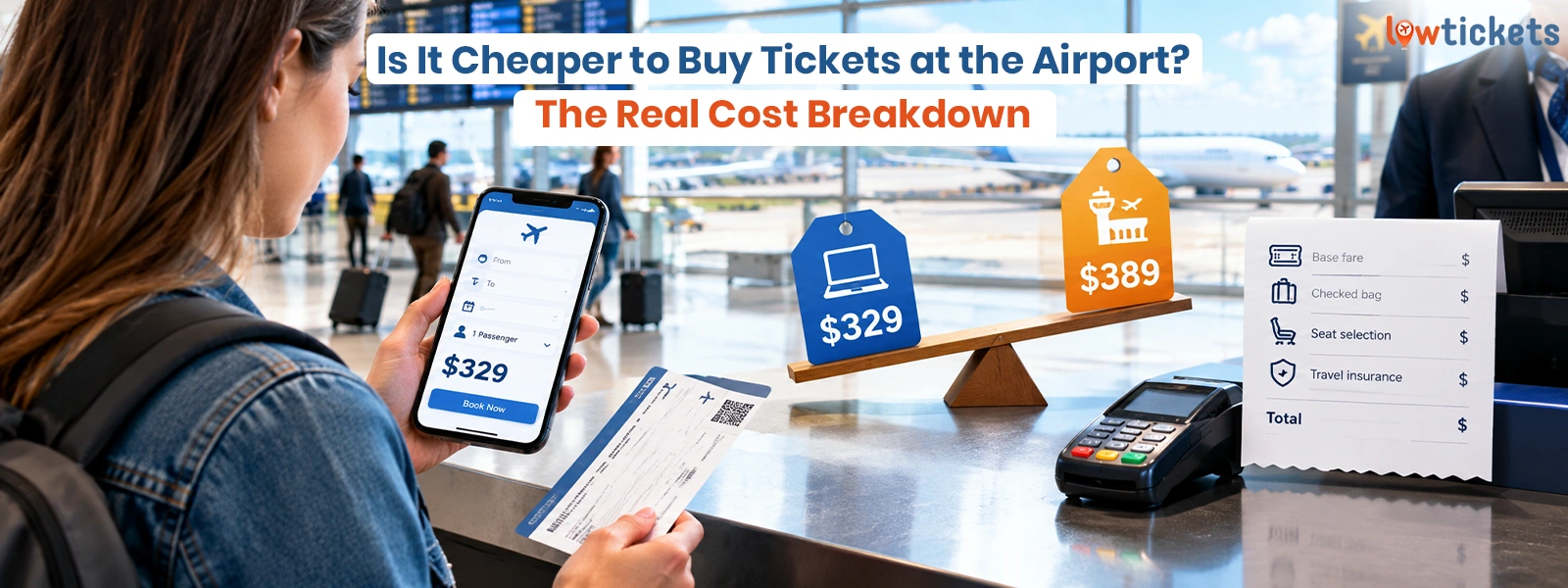
Table Of Content
No, going straight to the airport is not a cheaper option for most passengers, yet, yes, sometimes it can be done, saving real money under certain circumstances.
For the big airlines, the price at the ticket counter will always be equal to the price on the airline's website. The secret discount will work for ultra-low-cost carriers. Driving to the airport will bring you additional costs, which may ruin your calculations if you do not live nearby or purchase several tickets at once.
Before you choose any one mode for your booking, you have to figure out if the math works for you or not. Thus, begin the adventure of scrolling down and find the precise method to check whether your airport visit is financially beneficial for you. Apart from that, many important tips and insights, as well as the exact working hours of the respective desks, that you should know not to be sent home empty-handed.
The airport counters are normally set up to charge passengers for a higher fare class intended for those who have no other choice but to travel on that very day. This part explains the reason behind that and its implications for the cost-saving traveler.
This myth has real historical roots, but the airline pricing systems that inspired it stopped existing decades ago. Here's a quick look at where the idea started and why modern software makes it obsolete for anyone buying a cheap flight ticket today.
Part of the myth traces back to a simpler era of air travel, before yield management software existed.
Modern systems track booking pace in real time and respond by raising prices, not lowering them, as departure day approaches. Understanding this shift is the key to seeing why last minute flight booking rarely saves money anymore.
Confusion between these two concepts is one of the main causes of the persistence of the myth. This distinction is important because one of them is truly discounted while the other hardly ever is.
|
Term |
What it actually is |
Who can use it |
|
Standby fare |
A discounted, unconfirmed seat historically tied to airline employee travel or leftover inventory programs |
Airline staff, some loyalty tiers, rarely the general public |
|
Same day standby |
A free or low cost option to wait for an earlier or later flight you already hold a ticket for |
Passengers already ticketed for that day |
|
Walk up fare |
The highest priced fare bucket, sold to anyone buying a brand new ticket at the counter or gate |
Anyone, at whatever the current price happens to be |
Only the third row describes what most people mean by "buying a ticket at the airport," and it is the most expensive of the three by a wide margin.
Understanding the complete scenario is essential to face the last moment surprise in the form of cost increasing. Hence, lets uncover one by one and find out what is the relation between the Walk up fare and cost.
Airlines sell each flight in tiers, often labeled with letters internally, with the cheapest bucket released first, sometimes months ahead of departure. The system automatically rolls over to the next tier as buckets sell out. The top one or two buckets will be the only ones left by the time a person gets to the airport on his or her day of travel, and they just weren't supposed to be cheap.
A flight 40% filled three weeks ago is very different from a flight that is 95% filled at the time of its morning departure. The fewer seats there are on board, the more they'll cost, because the airline knows that many of the remaining seats will be filled. Airport purchases occur at the very spot in that curve, the time to be shopping for value.
From home, you can book on three airlines, two nearby airports, and some local dates in the time it takes to make a coffee! Stand at a ticket counter with a flight leaving in ninety minutes, and none of that exists. You're buying whatever that one airline has available on that one route, full stop.
There are a few genuine exceptions, though they're narrower than most people assume.
A Same-Day Confirmed Change on a Ticket You Already Own
This isn't a new purchase. It's a modification to an existing reservation, and airlines price it very differently from a walk-up fare.
Standby for Elite Frequent Flyer Members
Top tier status on Delta, American, or United often unlocks free standby for an earlier or later flight, something a general public buyer simply can't access.
A Rare Short-Term Promotional Fare
When airlines offer a “flash sale,” it is nearly always for a specific route and is typically sold online first, and often before the time the customer reaches the physical counter. In all other situations, it's close to the worst price you'll pay as a traveler buying a new one-way ticket, whether with cash or card.
If a same-day change is caused by an airline-side disruption rather than your own plans changing, you may also be covered under flight delay or flight cancellation protections instead of paying a change fee.
This is where most airport ticket articles fall off and it's the difference that saves people money. If you have an existing ticket and it has been cancelled, or you have had to alter your plans to leave earlier or later than you had planned, you are almost certainly better off changing your ticket than you are booking a new one at the counter. How the big U.S. carriers deal with it now:
These fees are separate from the post-ticketing fees that can apply after your original booking, so it's worth checking both before assuming a same-day change is your cheapest option.
|
Airline |
Same day confirmed change |
Same day standby |
|
Delta |
$75, waived for Gold Medallion and above; not available on Basic Economy |
Free for everyone; Basic Economy excluded |
|
American |
Roughly $60 to $150 depending on route, waived for Executive Platinum and Platinum Pro |
Free for all customers, list up to 45 minutes before departure |
|
United |
No flat fee; you pay the fare difference unless your original fare class is open, in which case Premier members change free |
Free for Premier members and many fare types |
|
Southwest |
No fee, but only available on Choice, Choice Preferred, or Choice Extra fares |
Not structured as a traditional standby fee model |
|
JetBlue |
$100 per person, free on Flex fares and for Mosaic members |
Airport only; can't be arranged online or by phone |
If you look at a brand new walk up ticket - which can easily be several times the price of the same day change fee - the math isn't hard to figure out. If you already have a ticket and simply want to switch flights within the same day, don't hesitate to inquire about a change.
There is one caveat to note: Both fare classes are unavailable for basic economy and the lowest fare class at nearly all airlines. When you booked, you were probably thinking about cost; look at your fare rules before assuming that changing a same-day ticket may be possible.
Chasing a last-minute deal creates a timing problem on top of the price problem, and most travelers underestimate both at once. This section covers the arrival windows that make late airport purchases even riskier.
Fare data across most U.S. domestic routes points to a sweet spot roughly one to three months before departure, while international routes tend to reward booking two to eight months out. Prices typically start climbing hard in the final one to two weeks before departure, which is the exact opposite pattern the "wait it out" theory assumes. For the full breakdown of airline booking windows by carrier, see our guide on how far in advance you can book flights.
There are multiple ways and tricks to put less load on your pocket while booking an airline ticket. And some of them are listed below from the ground-level expertise point of view.
Consider the airport ticket counter as a fallback, not as a plan. In most cases, getting the tickets beforehand will get you a much cheaper fare than what is possible on the day of travel because you will have the opportunity to compare dates and even airports. In case your plans are changed last minute, consider whether it is possible to change your existing ticket. Save the counter purchase for genuine emergencies, and do your price shopping from your couch, not from a check in line with a boarding cutoff closing in. Once you've booked from the couch, don't forget to check in online for your flight to skip the counter entirely.
Can you get a cheaper ticket by buying it at the airport?
Almost never. Airport purchases fall into the highest fare tier an airline sells, known as a walk up fare, and that tier exists specifically because it's sold to travelers with no other option.
Is booking a flight last minute ever cheaper than booking early?
Generally, no, whether that last minute booking happens online or at a physical counter. Occasional promotional exceptions exist, but they're rare and unpredictable enough that they shouldn't factor into anyone's travel budget.
Do unsold seats get discounted as departure gets closer?
No. Modern pricing software raises the price on remaining seats as a flight fills up rather than discounting them to clear inventory, which is the opposite of how many travelers assume it works.
What exactly is a walk up fare?
It's the highest priced fare class an airline publishes for a route, typically the only one still available to someone buying a ticket at the airport or within a day or two of departure.
Is a same day flight change cheaper than buying a new ticket at the airport?
Almost always, yes. A same day change modifies an existing reservation for a flat fee (often $60 to $100, sometimes free depending on airline and status), while a fresh airport purchase starts from the highest fare bucket on the plane.

Explore More Articles

What Happens If You Miss Your Flight? Here Is What to Do Next
Failure to board results can turn immediate into a no-show status which results in cancellation of all the other booked legs and penality of the fare ...
What Is Aer Lingus Name Change Policy Rules, Fees & How to Fix a Ticket Name
Your name change cannot be done online; reach out to Aer Lingus customer support or the original reservation agency at least two hours prior to depart...
What is Neos Air Name Change Policy Rules, Fees & How to Fix a Ticket Name
Changes to your booking with Neos Air can be made up until 48 hours prior to your scheduled departure time. But ultimately it will be the terms and co...

Best Places to Visit in Northern Italy Top Cities Worth Exploring
Deciding on where to go in the North of Italy becomes hard as there is much more to offer than just one typical tour route. Traveling in an absolutely...
Lowtickets is the smart choice for travelers who want it all, low fares, fast booking, and dependable support, built into one simple platform for every journey.
Quick Links
Top Destinations
Copyright © 2021 - 2026, Lowtickets. All rights reserved.