 ES
ES
 IT
IT
 DE
DE
 PL
PL
Is It Cheaper to Buy Tickets at the Airport? The Real Cost Breakdown
No, going straight to the airport is not a cheaper option for most passengers, yet, yes, sometimes it can be done, saving real money under certain cir...

 24/7 Flight Support
Click To Call
24/7 Flight Support
Click To Call
Call Us — Choose Your Region
24/7 support available in your language
 English
 French
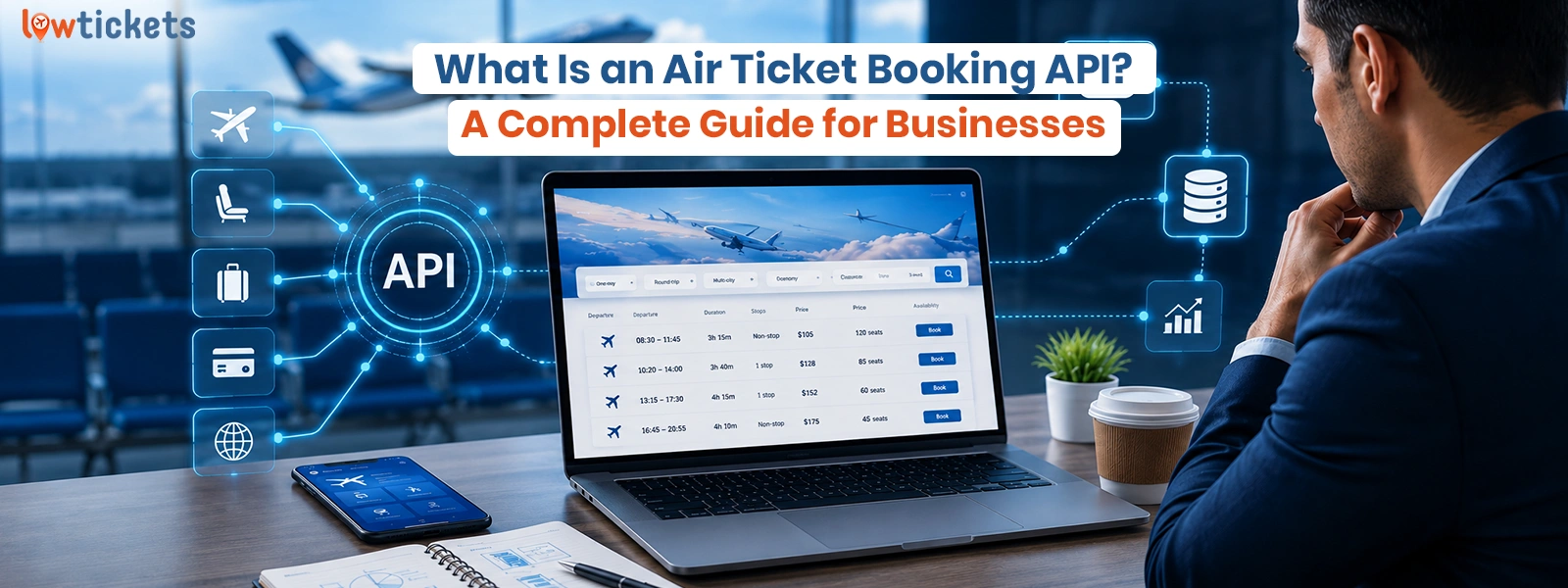
Table Of Content
Whether you're building a travel website, running a booking agency, or even incorporating flight search into your product, you've heard the word air ticket booking API a million times. It may sound technical, but understanding its purpose and how to pick the right one doesn’t require a computer science degree. This guide includes everything you need to know, explained simply, so you can make an informed decision without being confused by vendor speak.
An air ticket booking API is really just a connector between your app and everything happening behind the scenes on the airline side, whether that's the airlines themselves, the bigger distribution systems, or travel data providers. Instead of your team manually scraping flight info or shipping users off to some other site to actually book, the API takes care of that whole chain itself, searching, booking, confirming, getting the ticket issued, all of it so you're not stuck building that infrastructure from the ground up.
Think of it like a translator sitting in the middle of your app and this whole messy tangle of airline inventory systems. Ask for flights from Chicago to London next Tuesday, and you get something back you can actually show someone, prices, which seats are open, layovers, how many bags they get. Somebody picks a flight, and that same API handles the booking, runs the payment, gets the ticket cut. You never had to sit across a table and negotiate with a single airline to make any of that happen.
Companies in the travel industry don't reach for these APIs simply because it's the path of least resistance; there's a real practical calculation happening underneath that decision. Try building a flight booking system entirely on your own, and you'll quickly find yourself negotiating with airlines one at a time, chasing pricing that never sits still, and untangling ticketing standards that somehow manage to differ from carrier to carrier even though you'd expect some consistency. An API essentially absorbs all of that headache before your team ever has to touch it.
So here's what actually pulls businesses toward going this route in the first place:
The process behind an air ticket booking API involves several moving parts working together — here's how it breaks down step by step:
This typically runs on a REST or SOAP setup, with the data itself coming back as JSON or XML. Whoever's building the integration will usually be working off the vendor's documentation, plus a sandbox to test things out before it ever touches a real transaction.
Not every API pulls its data the same way, and knowing the difference can save you from ending up with something that doesn't really fit how your business works.
|
Type |
How It Works |
Best Suited For |
|---|---|---|
|
GDS-based API |
Runs through a Global Distribution System like Amadeus, Sabre, or Travelport, pulling from a huge range of airlines at once |
Bigger agencies and platforms after broad, established coverage |
|
NDC-based API |
Built on the airline industry's New Distribution Capability standard, giving a more direct, richer connection to individual carriers |
Businesses wanting detailed fare options, branded fares, personalized offers, that kind of thing |
|
Aggregator API |
Pulls data from GDSs, NDC connections, and low-cost carriers, all into one feed |
Startups and growing businesses after wide coverage without juggling several integrations at once |
|
Direct airline API |
Connects straight into a single airline's own booking system |
Businesses locked into one specific carrier or region rather than chasing global reach |
Picking a provider takes more than just comparing price sheets side by side. It really comes down to how well the API actually fits your existing systems, your customer base, and where you're hoping to take the business over the next few years.
Start with the markets and routes your customers actually care about. Some APIs lean hard toward domestic coverage, others are stronger on international routes or budget carriers, so line up the provider's strengths with where your users are actually flying. From there, take a real look at how it fits your existing tech stack, because a mismatch in supported languages or payment systems can quietly eat weeks of your development timeline before you even notice.
Pricing structure is worth slowing down for too, so some charge a flat subscription, some take a cut off every booking, and some blend both. Getting a handle on this early keeps you from getting blindsided once real transactions start coming through. And don't skip over how responsive their support actually is. Booking systems live and die on timing, so a provider that's slow to respond when something breaks isn't just annoying, it's actual lost revenue.
Once you've landed on a provider, the process tends to look pretty similar no matter which platform you're building, even if the technical specifics shift from vendor to vendor.
Pricing on these APIs swings a lot depending on the provider, how much volume you're pushing through, and what's actually bundled into the service.
Before signing anything, ask for a real cost breakdown based on what your expected volume actually looks like, and what's listed on a vendor's website rarely matches what you end up paying once real usage kicks in.
Connecting to the API is really just the start. Getting actual value out of it takes some ongoing effort. Cache search results for a bit to cut down on unnecessary calls; just don't hold onto them so long that pricing goes stale and customers end up annoyed. Build error messages that actually explain what went wrong for a failed booking, instead of dumping people on a generic screen that tells them nothing.
Keep tabs on how the API's actually performing over time, because even good providers hit slowdowns or outages now and then. Stay on top of version updates too, since older versions sometimes get deprecated without much warning. And honestly, it helps a lot to build a real relationship with the provider's support team. Having someone who actually knows your account tends to solve problems way faster than digging through documentation on your own.
Don't pick an air ticket booking API because it's the cheapest, this thing will stay with your platform for years. Look hard at coverage, pricing, documentation, and how quickly support actually shows up when something breaks. Expect the usual headaches, price mismatches and rate limits from the start, not after you’ve already been hit.
Not sure where to start? First write down what your business actually needs, and then measure providers against that, not their marketing page.
What's the difference between a GDS API and an NDC API?
GDS pulls data through a system that bundles a bunch of airlines together at once and NDC skips that middle layer and connects straight to individual carriers, which usually means better fare data since there's less in between.
How long does integrating an air ticket booking API usually take?
Really depends on how complex things get and simple setups run a few weeks to a couple months, mostly coming down to how experienced your team is and how much you're trying to customize.
Do I need a travel agency license to use one of these APIs?
Varies by provider, varies by where you're located too and some want specific business credentials before opening things up fully, so just ask upfront instead of guessing.
Can one API cover both domestic and international flights?
A lot of aggregator APIs handle both, yeah, though how good that coverage actually is shifts by region. Worth testing the routes that actually matter to your business before you commit to anything.
Can I switch providers after my platform's already live?
You can, but expect real rework as booking flows and error handling usually need to get rebuilt around whatever the new provider wants, so it's not exactly a quick swap.

Explore More Articles

Is It Cheaper to Buy Tickets at the Airport? The Real Cost Breakdown
No, going straight to the airport is not a cheaper option for most passengers, yet, yes, sometimes it can be done, saving real money under certain cir...

Best Places to Visit in Northern Italy Top Cities Worth Exploring
Deciding on where to go in the North of Italy becomes hard as there is much more to offer than just one typical tour route. Traveling in an absolutely...

The World’s Most Beautiful Sunsets Best Places to Watch the Sky Light Up
Have you ever been in a place where you had to experience "sunset time" and ended up catching just a part of it or even missing it due to th...

Qatar Airways Phone Number How Do I Speak to a Live Person?
You have landed here, and gravitation has no role in it, but the right connection is between your quest and solution. Hence, your searching spree for ...
Lowtickets is the smart choice for travelers who want it all, low fares, fast booking, and dependable support, built into one simple platform for every journey.
Quick Links
Top Destinations
Copyright © 2021 - 2026, Lowtickets. All rights reserved.